
Instruction
The investor defines security, side, quantity, order type, and any price or time condition.
The U.S. stock market is a network of issuers, exchanges, trading venues, brokers, market makers, clearing systems, and indexes. Understanding the roles prevents common errors such as treating an index as an exchange or a ticker as proof of a security’s identity.
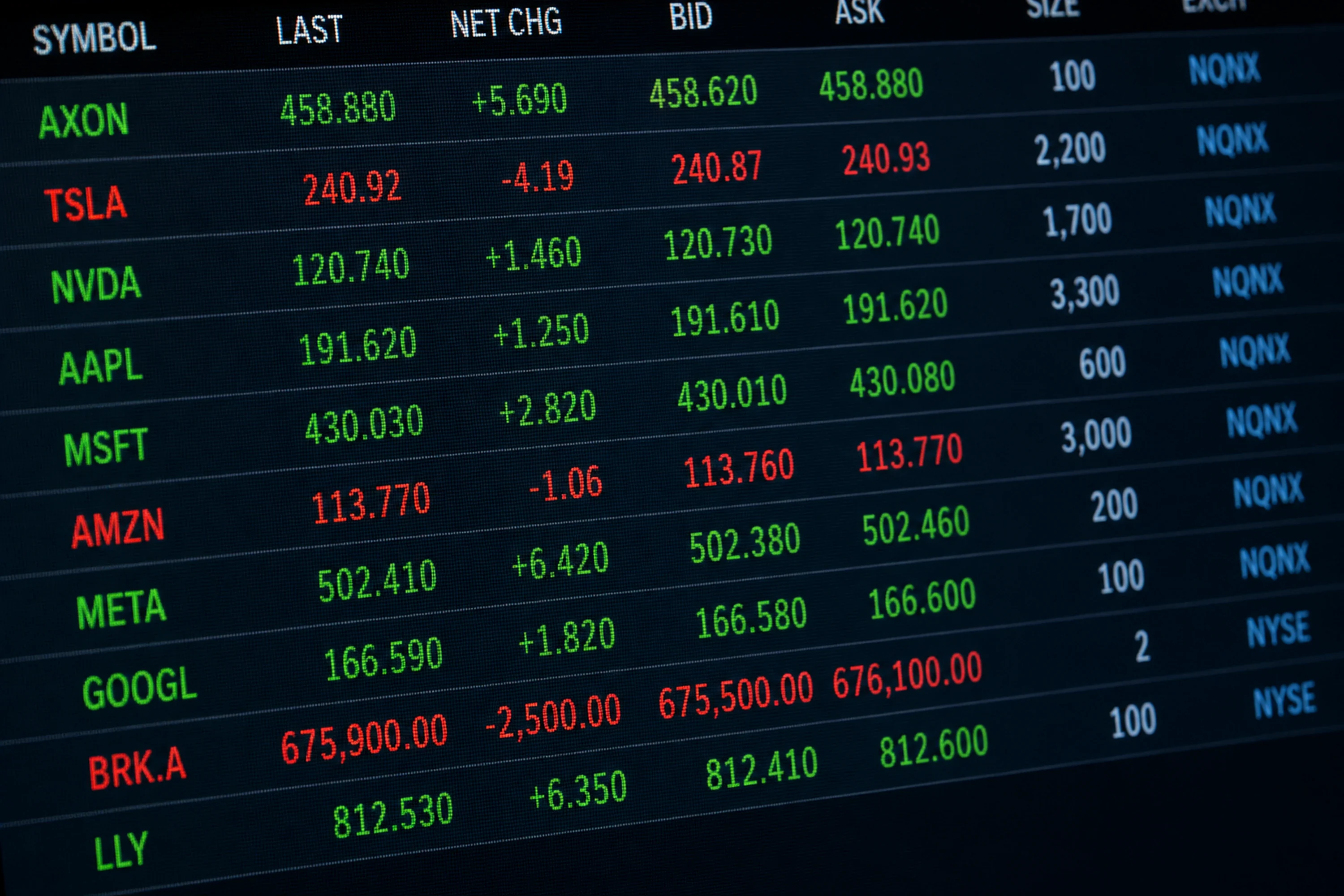
A stock represents an ownership interest in a corporation. Shareholders may benefit from price appreciation, dividends, voting rights, or corporate actions, but they also bear the risk that the business underperforms or fails. The U.S. stock market is the system through which these ownership interests are issued, quoted, traded, cleared, settled, and held.
Common shareholders are residual owners. Creditors and preferred claims generally rank ahead of common equity if a company is liquidated.
The most recognized listing markets are the New York Stock Exchange and Nasdaq. NYSE American is another national securities exchange. Securities may also trade through other registered exchanges, alternative trading systems, internal broker systems, wholesalers, and over-the-counter quotation venues.
| Venue | What it does | Investor note |
|---|---|---|
| NYSE | Lists and trades many established U.S. and international companies using electronic systems supported by designated market makers. | A listing venue is not the only place where a listed stock can execute. |
| Nasdaq | Electronic exchange and major listing market with a large concentration of technology and growth companies. | Quotes come from competing market participants and venues. |
| NYSE American | Exchange serving smaller and growing companies and other securities. | Formerly associated with the AMEX name. |
| OTC markets | Dealer-based quotation and trading outside national exchange listings. | Disclosure, liquidity, spreads, and fraud risk may differ substantially; perform additional due diligence. |
U.S. equities operate under a national market system. A broker may route an order to an exchange, market maker, alternative trading system, or another venue, subject to its best-execution obligations and routing arrangements.
Indexes are measurement tools, not directly investable products. Index funds and ETFs attempt to track them, but fees, trading costs, taxes, sampling, and timing can create a difference between fund and index returns.
| Index | Construction | What it is commonly used to represent |
|---|---|---|
| Dow Jones Industrial Average | 30 large U.S. companies; price-weighted. | A long-running snapshot of selected blue-chip companies. A higher-priced component has more index influence than a lower-priced one. |
| S&P 500 | About 500 leading U.S. companies; float-adjusted market-cap weighted. | A broad benchmark for large-cap U.S. equities and a common portfolio comparison standard. |
| Nasdaq Composite | Thousands of securities listed on Nasdaq; market-cap weighted. | A broad Nasdaq-listed universe with significant technology exposure. |
An index is a rules-based measurement portfolio, not an investable account by itself. Broad U.S. indexes can differ in eligibility, weighting method, reconstitution schedule, share-count treatment, free-float rules, sector exposure, and how corporate actions are handled. Price-weighted, market-cap-weighted, and equal-weighted indexes can tell different stories even when they contain similar companies. When a fund says it tracks an index, review both the index methodology and the fund’s implementation rather than assuming every “market” benchmark represents the same exposure.
The primary market is where new securities are issued and capital moves to an issuer or selling security holder under an offering structure. The secondary market is where existing investors trade securities with one another through exchanges and other venues. A company’s share price can move every second in the secondary market without new capital flowing to the company.
| Market activity | What happens | Investor checks |
|---|---|---|
| IPO | A private company becomes publicly traded through an offering and listing process. | Read the offering document, capitalization, use of proceeds, dilution, lockups, voting structure, risk factors, underwriters, and whether profitability/cash flow support the valuation. |
| Follow-on / secondary offering | A public company may issue new shares, or existing holders may sell shares, or both. | Separate primary shares that raise company capital from secondary shares sold by existing holders. Recalculate diluted share count and per-share economics. |
| Direct listing / other listing route | Existing shares can begin public trading under a structure different from a traditional underwritten IPO. | Understand which shares become tradeable, price discovery, liquidity, lockups, capital raised, and how the listing structure changes supply. |
| Secondary trading | Investors submit orders that interact across exchanges, market makers, ATSs, and other venues. | Focus on order type, session, spread, displayed depth, routing, fill quality, volatility, and settlement. |
In the primary market, newly issued securities raise capital or transfer existing ownership through an offering process; in the secondary market, investors trade existing securities with other market participants. IPOs, follow-on offerings, direct listings, private placements, and debt issuance have different disclosure, allocation, pricing, and dilution considerations. Once trading begins, the company usually does not receive cash from ordinary secondary-market trades. Distinguishing the two markets helps investors understand where proceeds go and why a new issue can change share count.
The exchange ticker is only one visible part of the market. A customer order passes through a broker and may interact with an exchange, market maker, alternative venue, or other execution process before the trade is cleared and settled.
The investor defines security, side, quantity, order type, and any price or time condition.
The broker applies its routing and execution process. The venue shown on a quote screen is not necessarily the only place liquidity exists.
A trade occurs when compatible interest meets under applicable market rules. The last price is not a guarantee of the next execution price.
Cash and securities move through post-trade processes after execution. Trade date and settlement date are separate events.
U.S. securities can trade across exchanges and other execution venues, while brokers route customer orders according to their systems and obligations. The consolidated quote and last-sale information do not mean every order is sent to one central marketplace.
Indexes are measurement tools rather than trading venues. A stock can be included in an index while trading on an exchange, and an ETF can seek to track that index while trading as its own security. Keeping issuer, security, venue, and index separate prevents common market-structure confusion.
The U.S. stock market is a network of issuers, exchanges, trading venues, brokers, market makers, clearing systems, and indexes. Understanding the roles prevents common errors such as treating an index as an exchange or a ticker as proof of a security’s identity.
A stock represents an ownership interest in a corporation. Shareholders may benefit from price appreciation, dividends, voting rights, or corporate actions, but they also bear the risk that the business underperforms or fails. The U.S. stock market is the system through which these ownership interests are issued, quoted, traded, cleared, settled, and held.
Common shareholders are residual owners. Creditors and preferred claims generally rank ahead of common equity if a company is liquidated.