
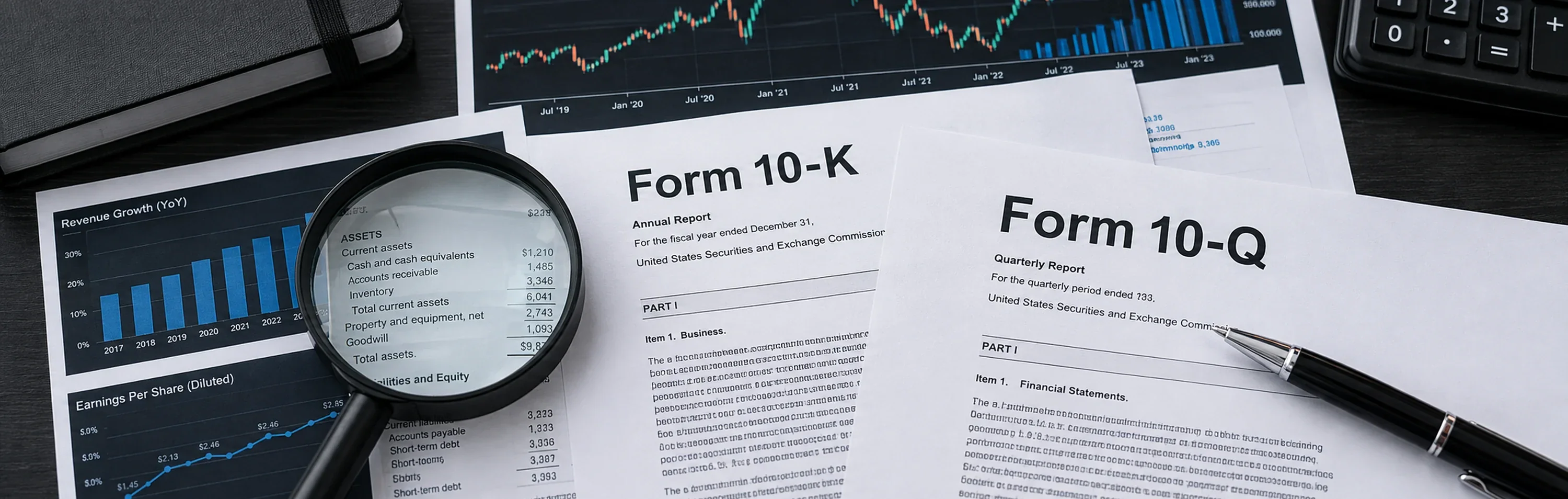
- Use the 10-K for the annual business, risk, audited financial, and management picture.
- Use the 10-Q for interim financial updates, material risks, and MD&A.
- Read the footnotes with the statements; important accounting choices and commitments often live there.
- Use 8-K filings to catch material events between scheduled reports.
Use filings as a system: business, risk, numbers, events, governance, then interpretation.
Company research becomes much stronger when each document is given the right job. A 10-K provides the annual business and audited-financial picture. A 10-Q updates the interim financial story. An 8-K reports many significant events between periodic filings. The proxy statement adds governance, ownership, voting, and executive-compensation context. Earnings releases are useful for speed and management framing, but the SEC filing remains the better anchor for the formal record.
| Document | Best used for | Question to ask |
|---|---|---|
| 10-K | Business model, risk factors, audited annual financials, MD&A, controls and exhibits | What business do I actually own, and what could materially change the economics? |
| 10-Q | Interim financials and updated business/risk discussion | What changed since the annual filing? |
| 8-K | Significant events between periodic reports | Does this event change the thesis, capital structure, leadership, or expected cash flows? |
| Proxy | Board, voting, ownership, pay design, related-party context | Are incentives and governance aligned with long-term shareholder outcomes? |
| Earnings release | Fast summary and management framing | Which claims must be reconciled with the filed statements and notes? |
Use a repeatable filing reading sequence
How does the company generate revenue, and what segments or customers matter?
Which operating, financial, regulatory, or market risks are material?
How does management explain results, liquidity, trends, and uncertainties?
Income statement, balance sheet, cash flow, equity, and footnotes.
Know the different jobs of the 10-K and 10-Q
| Filing | Primary job | Use it for |
|---|---|---|
| 10-K | Annual report filed with the SEC | Business, risk factors, audited annual financials, MD&A, controls, exhibits. |
| 10-Q | Quarterly report | Unaudited interim financials, updates to risks, MD&A for the quarter. |
| 8-K | Current report | Material events and information between periodic reports. |

Do not stop at headline earnings
Revenue recognition, stock compensation, debt terms, acquisitions, contingencies, segment detail, fair-value assumptions, taxes, pensions, and other topics may require the footnotes to understand the quality and durability of the headline numbers.
Compare disclosures across periods
Search for changes in language, segment reporting, risk factors, liquidity discussion, estimates, non-GAAP adjustments, and capital allocation. A change in disclosure can be as informative as a change in a ratio.
Research mistakes that weaken a filing-based conclusion
Research mistakes usually begin when a chart, headline, adjusted metric, or management narrative is accepted before the primary filing and accounting evidence are reconciled.
Using a headline metric or management summary without tracing the number back to the filing, footnotes, period, and accounting definition.
Reading one quarter in isolation instead of comparing the business model, cash flow, capital structure, revisions, and multi-period evidence.
Writing a conclusion without identifying what evidence would weaken the thesis or require a valuation and risk review.
Use a filing map instead of reading front to back
A filing is long because it serves legal, accounting, governance, and investor-information functions at the same time. For research, move through it in a sequence that connects the business model to the numbers and then to the risks that could change those numbers.
| Pass | 10-K / 10-Q area | Investor question |
|---|---|---|
| 1. Business | Business and segment description | How does the company generate revenue, who pays it, and what inputs or relationships matter? |
| 2. Risk | Risk factors and legal proceedings | Which risks could change revenue, margins, financing, or the company's ability to operate? |
| 3. Management view | MD&A | What changed, why does management say it changed, and what assumptions are embedded in that explanation? |
| 4. Financials | Statements and footnotes | Do earnings, cash flow, balance-sheet changes, and accounting policies tell a consistent story? |
| 5. Change log | Current-quarter updates and 8-Ks | What is materially different from the prior annual report? |
Build a one-page filing summary
After reading, record revenue drivers, margin drivers, cash conversion, balance-sheet constraints, dilution or capital-allocation issues, the three most decision-relevant risks, and the next filing item that could confirm or weaken the thesis. This keeps a long filing connected to a short set of testable conclusions.
Before forming an investment conclusion
Name the primary evidence, the assumption doing the most work, and the new fact that would weaken or overturn the thesis.
Why read both MD&A and the footnotes?
MD&A explains management’s view of results and trends; footnotes provide detailed accounting policies, obligations, and statement context.
Is a 10-Q simply a shorter 10-K?
No. It is an interim filing with different scope and timing; use it to update the annual baseline and read the full filing context.
How to read an 8-K
A practical reading sequence for Form 8-K: identify the triggering event, read the relevant item, compare it with prior filings, and separate facts from interpretation.
Start with the event, not the headline
Open the filing on EDGAR and identify the date, item number, and event being reported. Then read the specific item before reading outside commentary.
What happened, and when?
Which 8-K item contains the required disclosure?
Are there contracts, earnings materials, presentations, or other exhibits?
How does the disclosure differ from the last 10-K or 10-Q?
Separate a material change from routine noise
Ask whether the event changes the company’s economics, governance, financing, liquidity, accounting, leadership, or risk profile. A filing can be important even when it does not immediately change revenue or earnings.
- Financing or debt changes can affect liquidity and future obligations.
- Leadership, auditor, or accounting changes can alter the interpretation of future reports.
- Acquisitions, disposals, restructurings, or impairments can materially change the economics of the business originally under review.
Cross-check the filing against the company’s prior story
Write down the exact claim that changed, then locate the prior disclosure. This prevents a fresh press release from replacing the investor's memory of what management previously said.
What did the company previously say about the issue?
What new obligation, number, risk, or decision has been filed?
Record the investor-relevant implication
Finish with one sentence describing what changed and one sentence describing what the investor still need to verify. That short record is more useful than saving the filing without a decision note.
Earnings release vs. SEC filing
Earnings releases, Forms 10-Q and 10-K, and related 8-K filings serve different purposes and should be reconciled rather than read as isolated headline metrics.
Give each document the right job
Headline results, management framing, selected operating metrics, guidance, and often non-GAAP measures.
Financial statements, notes, MD&A, risk updates, controls, and standardized filing context.
Reconcile the numbers before interpreting the narrative
Build a small bridge from the headline to the filed statements. If a metric is adjusted, identify the reconciliation and what was excluded. If cash flow diverges from earnings, understand why.
- Revenue and segment mix
- Operating income and margins
- Net income and earnings per share
- Operating cash flow and capital spending
- Debt, cash, share count, and major balance-sheet changes
Read the language that changed
Compare management wording with the prior quarter. A shift from confident language to more conditional wording, or a newly emphasized risk, can matter even when the headline number beats expectations.
Finish with a short evidence table
Record what beat or missed the investor's prior expectation, what changed in the filed facts, and what the investor will watch next quarter. Avoid converting a one-quarter surprise into a permanent trend without evidence.
Proxy statement basics
A practical guide to the proxy statement: board elections, executive compensation, shareholder proposals, related-party matters, ownership, and voting decisions.
Begin with what shareholders are voting on
Identify the annual meeting date, record date, proposals, board nominees, auditor ratification, compensation votes, and any shareholder proposals. Then decide which items need deeper review.
Evaluate the board as a decision system
Do director backgrounds match the company’s major risks and strategy?
Which directors are independent and how are key committees composed?
Is the board balancing continuity with fresh oversight?
How does the board respond to prior voting results or governance concerns?
Connect compensation design to outcomes
Look beyond total compensation. Review performance conditions, equity awards, vesting, peer groups, and incentives that could encourage excessive short-term risk.
Use ownership and related-party disclosures as context
Large insider ownership can align interests in some circumstances, while related-party transactions or unusual arrangements deserve careful reading. Record what matters for the investor's investment thesis.
How to read financial-statement footnotes
The notes to financial statements explain accounting policies, estimates, debt, leases, taxes, stock compensation, acquisitions, contingencies, segments, fair value, and other details that can change how headline numbers should be interpreted.
Use a fixed footnote reading route
Revenue recognition, inventory, depreciation, consolidation, estimates.
Debt, leases, commitments, contingencies, pensions where relevant.
Stock compensation, repurchases, acquisitions, goodwill, noncontrolling interests.
Tie footnote tables back to statement line items, cash flow, and MD&A.
Accounting policies define what the headline number means
Revenue, inventory, depreciation, credit losses, fair value, and other accounting choices can affect timing and classification. A company comparison is stronger when the underlying policy is understood, not merely the ratio.
Look for claims that are not obvious from one line item
Debt maturity schedules, lease obligations, legal contingencies, guarantees, purchase commitments, and variable-interest arrangements can reveal timing and conditional obligations that a single balance-sheet figure cannot show.
Footnote-reading mistakes that can hide a change in the economics
- Reading only the primary statements and skipping the notes.
- Comparing margins across firms without checking revenue-recognition differences.
- Ignoring changes to estimates or segment definitions.
- Relying on a data vendor when the filed note contains the needed context.
Use the filing that answers the question instead of reading one document in isolation
A 10-K, 10-Q, 8-K, proxy statement, and ownership filing answer different research questions. Build a filing map around the thesis so important governance, event, or dilution evidence is not missed simply because it is outside the annual report.
| Filing / source | Typical research purpose |
|---|---|
| 10-K | Annual business description, risk factors, audited financial statements, notes, MD&A, controls |
| 10-Q | Interim financial statements, updated MD&A, changing risks and liquidity between annual reports |
| 8-K | Material events disclosed between periodic reports; read the specific item and exhibits |
| Proxy statement | Governance, executive compensation, voting matters, ownership information and related disclosures |
| Ownership / registration filings | Insider holdings/trades, major ownership, securities issuance or capital-structure questions as applicable |
Read a 10-K in an evidence order, not page order
A 10-K combines the business description, material risks, management's explanation of results, audited financial statements, and detailed notes. Reading those pieces as a connected evidence chain is usually more useful than reading from the first page to the last.
| Pass | Section | Question |
|---|---|---|
| 1 | Business | How does the company generate revenue, and what must remain true for the model to work? |
| 2 | Risk factors | Which risks could materially change the business, financing, or investor outcome? |
| 3 | MD&A | How does management explain the change in revenue, margins, cash flow, capital needs, and known uncertainties? |
| 4 | Financial statements | Do the income statement, balance sheet, and cash flow statement support the narrative? |
| 5 | Footnotes | Which accounting policies, commitments, concentrations, or one-time items change the meaning of the headline numbers? |