

- Uninvested cash may be treated differently depending on the sweep election.
- Buying power, settled cash, and withdrawable cash are related but not identical concepts.
- Settlement links the trade date to the final exchange of cash and securities.
- Protection depends on where the cash is legally held, not on the screen label alone.
The standard U.S. settlement cycle for most applicable securities is currently T+1, but settlement conventions, sweep yields, bank allocations, and product terms can change. Verify the current firm disclosures.
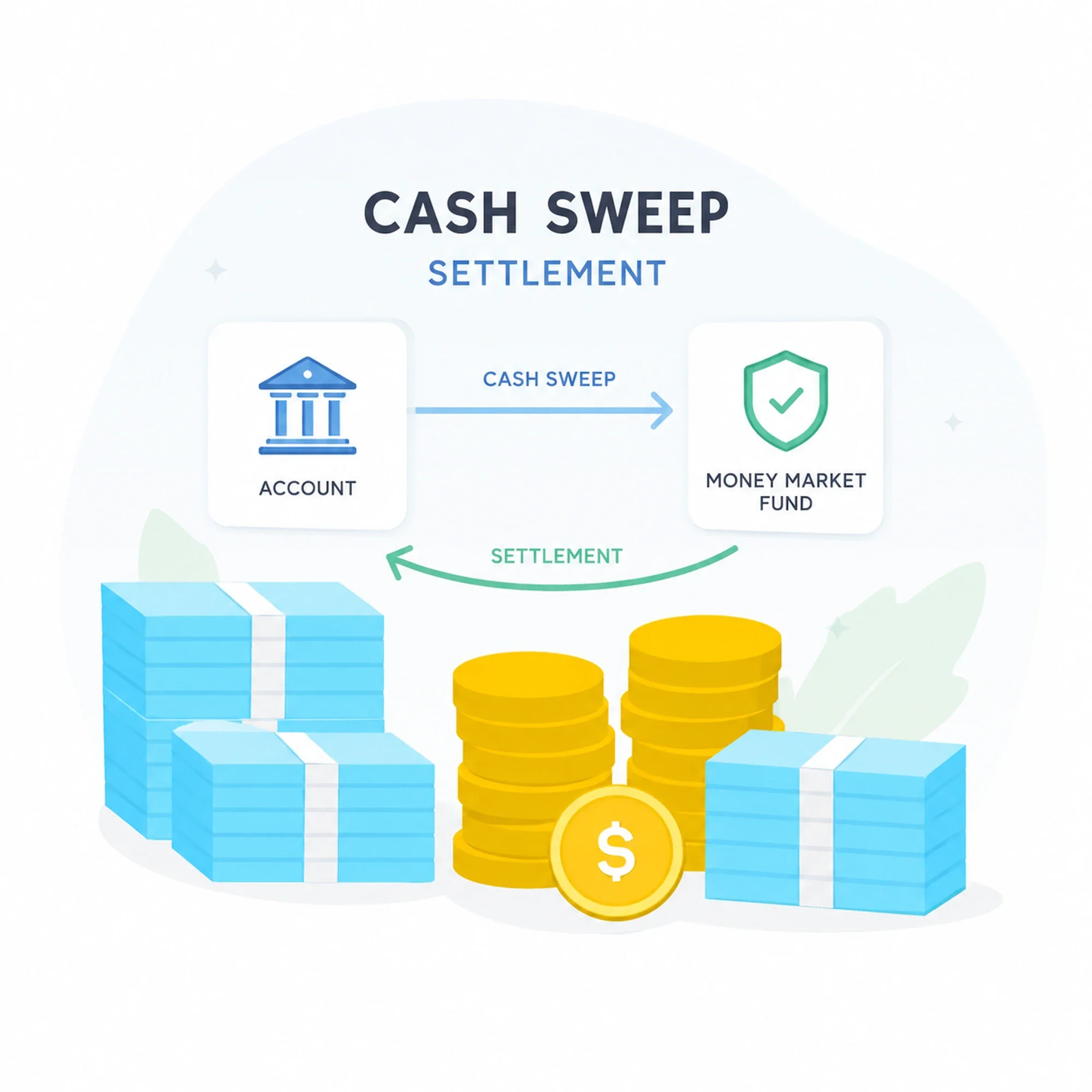
The cash path
Cash arrives from payroll, bank transfer, sale proceeds, or another account.
Excess cash may remain at the broker, move to a bank deposit program, or move to a money market mutual fund.
The platform calculates what can be used for new purchases under the account rules.
An order executes and creates a transaction that must settle.
Cash and securities are delivered according to the applicable settlement cycle.
Availability depends on settlement, holds, account type, and firm procedures.
Three cash labels can mean three different structures
| Structure | What it is | What to verify |
|---|---|---|
| Brokerage cash balance | Cash held within the brokerage arrangement. | Review the account agreement and SIPC status; protection is not the same as FDIC deposit insurance. |
| Bank deposit sweep | Cash swept to one or more participating banks. | May be eligible for FDIC insurance subject to applicable ownership categories, bank allocations, and limits. |
| Money market mutual fund | A security that invests in short-term instruments. | Not an FDIC-insured bank deposit; investment value and yield depend on the fund and market conditions. |
Do not use one cash number for every decision
Platforms can display available cash, settled cash, cash available to trade, buying power, and cash available to withdraw. The definitions can differ by account type and firm. Before an important trade or transfer, identify which balance is relevant to the action the investor is about to take.
Settlement is operational, not a forecast
Settlement is the completion process after execution. For many U.S. securities, the current standard is one business day after the trade date. A shorter cycle changes when payment or delivery is due, but it does not change the investment thesis or guarantee immediate withdrawal availability.
- Confirm the security’s settlement convention.
- Know whether the account is cash or margin.
- Understand holds on recent deposits.
- Check whether sale proceeds are settled before relying on them for another purchase or withdrawal.
Monthly cash review
- Cash balance matches the planned reserve or allocation.
- Sweep vehicle matches the intended liquidity and protection profile.
- Unexpected idle cash is investigated.
- Margin debit or interest is not appearing unintentionally.
- Recent sales, dividends, and transfers reconcile with the statement.
Mistakes that confuse cash labels with cash availability
Treating buying power, settled cash, available-to-withdraw cash, and sweep balances as interchangeable.
Assuming every cash sweep has the same yield, insurance status, liquidity, or counterparty arrangement.
Moving cash immediately after trading without checking settlement and the firm’s current withdrawal or transfer rules.
Separate trade date, settlement date, and withdrawable cash
A brokerage balance can show several different ideas at once: cash that has settled, proceeds from a recent sale, buying power, a sweep position, and cash that can actually be withdrawn. Treat those as separate fields instead of assuming every dollar labeled “cash” has the same status.
| Field | What it means | Control question |
|---|---|---|
| Trade date | The day the buy or sell order executes. | What obligation did the trade create? |
| Settlement date | The day cash and securities are due to complete the transaction. | Has the transaction reached the point at which delivery is complete? |
| Sweep or core cash | Where eligible idle cash is held under the account's cash-management setup. | What instrument or bank program is the cash actually in, and what yield, fees, or protections apply? |
| Buying power | A trading-capacity figure that may reflect settled cash, pending activity, and account permissions. | Is the amount fully funded cash, or does it rely on margin or unsettled activity? |
| Available to withdraw | The amount the firm currently permits to leave the account. | Are any trades, deposits, holds, or settlement obligations still pending? |
Protection is tied to what the cash actually is
SIPC protection applies in a narrow broker-dealer failure context and is not insurance against market losses. Bank sweep deposits, money market mutual funds, and brokerage cash can have different structures and protection regimes. Identify the actual destination before relying on a label such as “cash” or “sweep.”
Follow the cash from execution through settlement
Use the confirmation and balances page together. The confirmation explains what executed; the balances page shows how the firm currently classifies settled cash, unsettled activity, buying power, the sweep position, and the amount available to withdraw. Those fields can answer different questions.
Before treating account cash as available cash
Reconcile the screen labels to pending trades, settlement dates, sweep rules, holds, and any margin or credit feature so the amount that is actually available is not confused with a larger trading-power number.
Why can “cash available,” “buying power,” and “settled cash” show different amounts?
They can reflect different account rules, pending trades, margin or credit features, sweep mechanics, and settlement timing. The label must be interpreted in the context of the account type and pending activity.
What should be checked before assuming a cash balance is final and withdrawable?
Review pending trades, settlement dates, deposits or holds, sweep status, margin obligations, and the broker’s current withdrawal or settlement rules.