
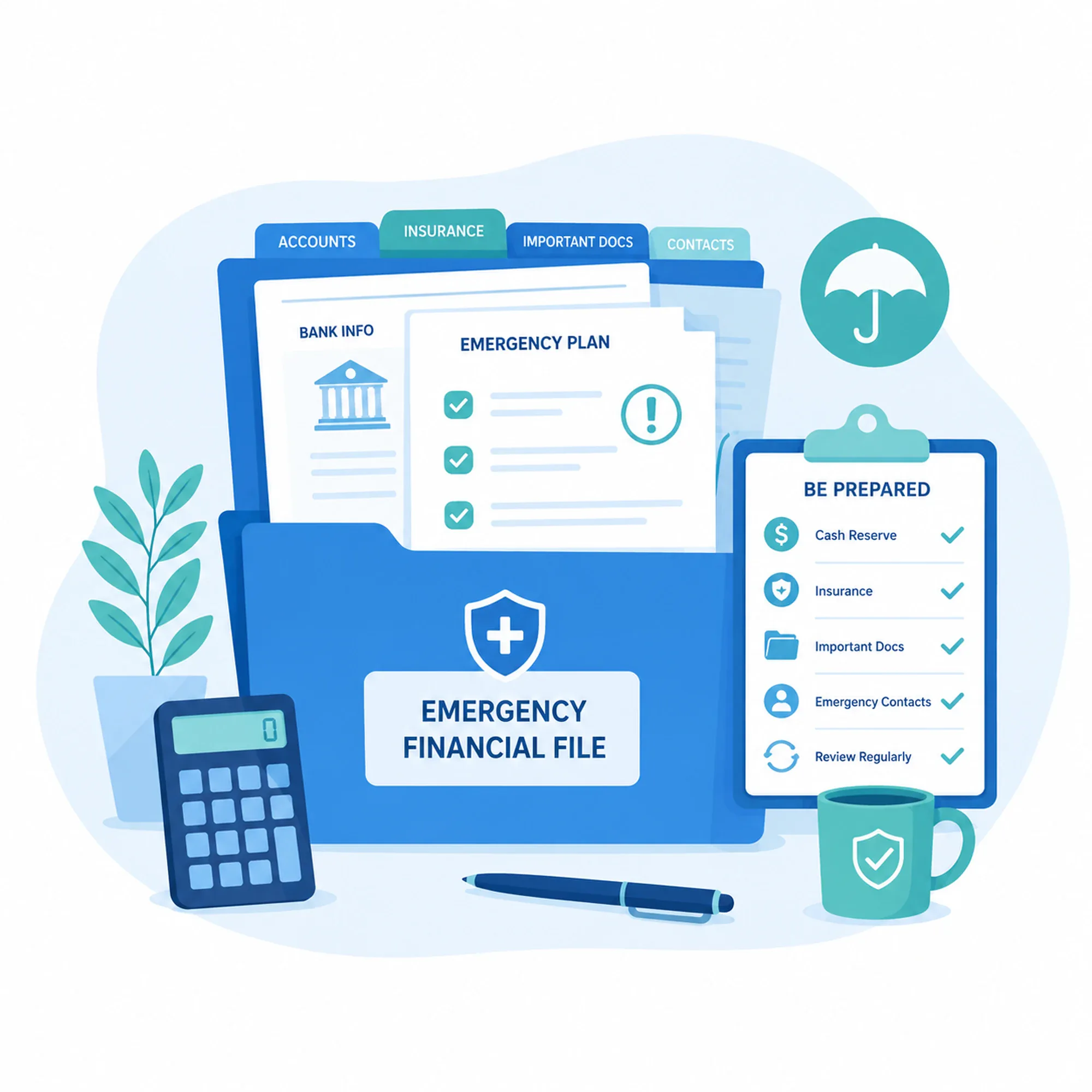
- An emergency file is a map to essential records, not a reason to store every password in plain text.
- Include account inventory, insurance, key contacts, legal documents, recurring obligations, and important deadlines.
- Document where originals are stored and who has authority to act.
- Review the file at least annually and after a major life event.
Institution procedures, legal authority, digital-access rules, and document requirements vary. Verify current requirements and use secure storage practices.

Build a map before collecting documents
Accounts, loans, property, insurance, recurring bills, tax records, and employer benefits.
Family contacts, adviser, attorney, tax professional, executor, trustee, trusted contact, and power of attorney where applicable.
Separate access instructions from raw credentials
Document the secure method used to access important records rather than copying passwords into an unprotected file. Turn on strong account security and make sure trusted people know how to locate the instructions.
Include a first-week checklist
- Secure cash-flow needs and urgent bills.
- Contact the relevant employer, insurer, financial institutions, or legal representatives.
- Locate current account and beneficiary records.
- Preserve statements and notices before changing anything.
Give the file an owner and a review date
A stale emergency file can be more confusing than no file at all. Record who maintains it, where it is stored, and when it was last reviewed.
Mistakes that make an emergency financial file unusable
Storing passwords, recovery codes, account numbers, and identity documents together in an insecure file simply for convenience.
Creating an account inventory once and never updating institutions, contacts, beneficiaries, insurance, debts, or recurring obligations.
Building a file that lists assets but does not explain who has authority, where controlling documents are kept, or whom to contact during an emergency.
Design the emergency file around actions someone may need to take
A useful emergency file is not a pile of statements. It is a controlled index that tells a trusted person what exists, where to find it, and who to contact without unnecessarily exposing passwords or sensitive documents. Separate the inventory from the credentials used to access accounts.
| Category | Index should identify | Security note |
|---|---|---|
| Cash and banking | Institution, account purpose, owner, contact channel | Do not place online-banking passwords in an ordinary shared document. |
| Investments / retirement | Broker or plan, account type, beneficiary review date, adviser/contact if any | Keep account statements and access credentials under appropriate controls. |
| Insurance | Carrier, policy type, policy number/location, claims contact | Make sure the person who may need the policy knows it exists. |
| Debt and recurring bills | Lender/provider, due date, autopay source, customer-service contact | An emergency can create missed payments even when enough cash exists. |
| Legal / authority | Attorney if any, document location, agent or executor details | Possessing a document is not the same as having legal authority under it. |
Layer 1 is the human-readable inventory: what exists and who handles it. Layer 2 is protected access: the actual statements, identity documents, secure credential manager, or physical originals. This reduces the chance that a single lost file exposes every account while still allowing a family or authorized agent to reconstruct the financial system.
Organize the file by action, not by document type
In an emergency, the person helping needs to know what exists, who has authority, whom to contact, and which deadline matters. A stack of statements without an index can still be unusable.
| Action | Index should point to |
|---|---|
| Keep bills and income moving | Bank relationships, recurring payments, payroll/pension contacts, near-term cash source |
| Protect accounts | Financial institutions, trusted contact information, fraud-reporting path, device/access recovery instructions |
| Act with authority | POA, trustee, executor, guardian, or other governing documents and professional contacts |
| Handle investments | Brokerage/retirement account list, adviser or firm contacts, investment policy or restrictions |
| Handle taxes and insurance | Recent returns, tax preparer, policies, claims contacts, key deadlines |
Record the difference between contact, authority, and ownership
An emergency file should state who owns each account, who may act under a valid authority, who the institution may contact for protective reasons, and who is named to receive assets. Those roles are different and should not be stored as if they were interchangeable.
| Role | Emergency use | What the file should record |
|---|---|---|
| Owner | Controls the account while able to act | Registration, institution, account purpose, and location of governing documents |
| Authorized agent / POA | May act within the authority granted by valid documents and institution procedures | Document location, effective date, agent contact, institution requirements |
| Trusted contact | May be contacted by the firm in limited protective circumstances | Name, relationship, current contact details; do not list as transaction authority unless separately authorized |
| Beneficiary | May receive assets after death under the applicable account transfer rules | Designation, date last reviewed, and whether it matches the broader estate plan |
Before relying on the emergency financial file
Test the file as if the investor was unavailable: another authorized person should be able to locate the institution, account or policy, governing document, legitimate authority, and current contact path without needing a password shared informally.
What information would another trusted person need during an emergency?
Gather the records another person would actually need, verify that they are current, and note where the originals are kept.
Which documents should be stored, and where should access instructions live?
Record where the authoritative documents are stored, who maintains the file, who has legitimate authority, and the date each item was last verified.
When should the emergency file be refreshed?
Review the file whenever an account, policy, beneficiary, legal authority, trusted person, institution contact, or document location changes, and perform a scheduled check at least often enough that another person would not be relying on stale records.